#include <pddp.h>
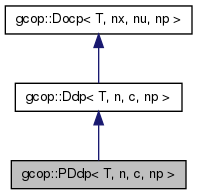
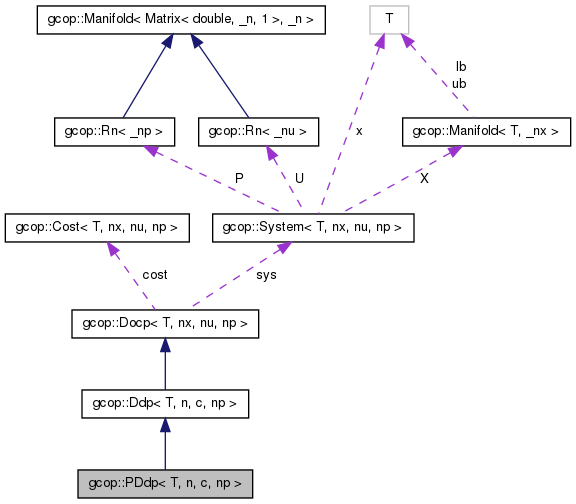
Public Member Functions | |
| PDdp (System< T, n, c, np > &sys, Cost< T, n, c, np > &cost, vector< double > &ts, vector< T > &xs, vector< Vectorcd > &us, Vectormd &p, int dynParams=0, bool update=true) | |
| void | Iterate () |
| void | Update (bool der=true) |
| void | Forward () |
| void | Backward () |
| bool | pdX (const MatrixXd &P) |
Public Attributes | |
| int | m |
| parameter space dimension | |
| int | dynParams |
| number of dynamic parameters (that the dynamics depend on) | |
| VectorXd & | p |
| reference to parameters being optimized | |
| VectorXd | dp |
| computed parameter increment | |
| std::vector< Matrixnmd > | Cs |
| std::vector< MatrixXd > | Kuxs |
| VectorXd | Lxa |
| MatrixXd | Lxxa |
| Vectorcd | Lu |
| Matrixcd | Luu |
| MatrixXd | Lxua |
| VectorXd | v |
| MatrixXd | P |
| double | nu |
| current regularization factor nu | |
| double | nu0 |
| minimum regularization factor nu | |
| double | dnu0 |
| regularization factor modification step-size | |
| bool | printDebug |
template<typename T, int n = Dynamic, int c = Dynamic, int np = Dynamic>
class gcop::PDdp< T, n, c, np >
Constructor & Destructor Documentation
| gcop::PDdp< T, n, c, np >::PDdp | ( | System< T, n, c, np > & | sys, |
| Cost< T, n, c, np > & | cost, | ||
| vector< double > & | ts, | ||
| vector< T > & | xs, | ||
| vector< Vectorcd > & | us, | ||
| Vectormd & | p, | ||
| int | dynParams = 0, |
||
| bool | update = true |
||
| ) |
Create a parameter-dependent optimal control problem using a system, a cost, and a trajectory given by a sequence of times, states, controls, and parameters. The times ts must be given, the initial state xs[0] must be set, and the controls us and parameters p will be used as an initial guess for the optimization.
After initialization, every call to Iterate() will optimize the controls us, states xs, and parameters p and modify them accordingly. Problems involving time-optimization will also modify the sequence of times ts.
- Parameters:
-
sys system cost cost ts (N+1-vector) sequence of discrete times xs (N+1-vector) sequence of discrete states us (N-vector) sequence of control inputs p (m-vector) parameters dynParams how many of these are dynamic parameters (i.e. that the dynamics depends on), the first dynParams in the parameter vector p will be regarded as the dynamic parameters update whether to update trajectory xs using initial state xs[0], inputs us, and parameters p. This is necessary only if xs was not already generated.
References gcop::PDdp< T, n, c, np >::Cs, gcop::PDdp< T, n, c, np >::Kuxs, gcop::PDdp< T, n, c, np >::Lxa, gcop::PDdp< T, n, c, np >::Lxua, gcop::PDdp< T, n, c, np >::Lxxa, gcop::PDdp< T, n, c, np >::m, gcop::Ddp< T, n, c, np >::N, gcop::Manifold< T, _n >::n, gcop::PDdp< T, n, c, np >::printDebug, gcop::System< T, _nx, _nu, _np >::U, gcop::PDdp< T, n, c, np >::Update(), and gcop::System< T, _nx, _nu, _np >::X.
Member Function Documentation
| void gcop::PDdp< T, n, c, np >::Backward | ( | ) |
Backward pass
Reimplemented from gcop::Ddp< T, n, c, np >.
| void gcop::PDdp< T, n, c, np >::Forward | ( | ) |
Forward pass
Reimplemented from gcop::Ddp< T, n, c, np >.
| void gcop::PDdp< T, n, c, np >::Iterate | ( | ) | [virtual] |
Perform one DDP iteration. Internally calls:
Backward -> Forward -> Update. The controls us and trajectory xs are updated.
Reimplemented from gcop::Ddp< T, n, c, np >.
| bool gcop::PDdp< T, n, c, np >::pdX | ( | const MatrixXd & | P | ) | [inline] |
Reimplemented from gcop::Ddp< T, n, c, np >.
| void gcop::PDdp< T, n, c, np >::Update | ( | bool | der = true | ) |
Update the trajectory and (optionally) its linearization
- Parameters:
-
der whether to update derivatives (A and B matrices)
Reimplemented from gcop::Docp< T, nx, nu, np >.
Referenced by gcop::PDdp< T, n, c, np >::PDdp().
Member Data Documentation
| std::vector<Matrixnmd> gcop::PDdp< T, n, c, np >::Cs |
Referenced by gcop::PDdp< T, n, c, np >::PDdp().
| double gcop::PDdp< T, n, c, np >::dnu0 |
regularization factor modification step-size
| VectorXd gcop::PDdp< T, n, c, np >::dp |
computed parameter increment
| int gcop::PDdp< T, n, c, np >::dynParams |
number of dynamic parameters (that the dynamics depend on)
| std::vector<MatrixXd> gcop::PDdp< T, n, c, np >::Kuxs |
Reimplemented from gcop::Ddp< T, n, c, np >.
Referenced by gcop::PDdp< T, n, c, np >::PDdp().
| Vectorcd gcop::PDdp< T, n, c, np >::Lu |
Reimplemented from gcop::Ddp< T, n, c, np >.
| Matrixcd gcop::PDdp< T, n, c, np >::Luu |
Reimplemented from gcop::Ddp< T, n, c, np >.
| VectorXd gcop::PDdp< T, n, c, np >::Lxa |
Referenced by gcop::PDdp< T, n, c, np >::PDdp().
| MatrixXd gcop::PDdp< T, n, c, np >::Lxua |
Referenced by gcop::PDdp< T, n, c, np >::PDdp().
| MatrixXd gcop::PDdp< T, n, c, np >::Lxxa |
Referenced by gcop::PDdp< T, n, c, np >::PDdp().
| int gcop::PDdp< T, n, c, np >::m |
parameter space dimension
Referenced by gcop::PDdp< T, n, c, np >::PDdp().
| double gcop::PDdp< T, n, c, np >::nu |
current regularization factor nu
| double gcop::PDdp< T, n, c, np >::nu0 |
minimum regularization factor nu
| VectorXd& gcop::PDdp< T, n, c, np >::p |
reference to parameters being optimized
Reimplemented from gcop::Docp< T, nx, nu, np >.
| MatrixXd gcop::PDdp< T, n, c, np >::P |
Reimplemented from gcop::Ddp< T, n, c, np >.
| bool gcop::PDdp< T, n, c, np >::printDebug |
Referenced by gcop::PDdp< T, n, c, np >::PDdp().
| VectorXd gcop::PDdp< T, n, c, np >::v |
Reimplemented from gcop::Ddp< T, n, c, np >.
The documentation for this class was generated from the following file:
- lib/algos/pddp.h